

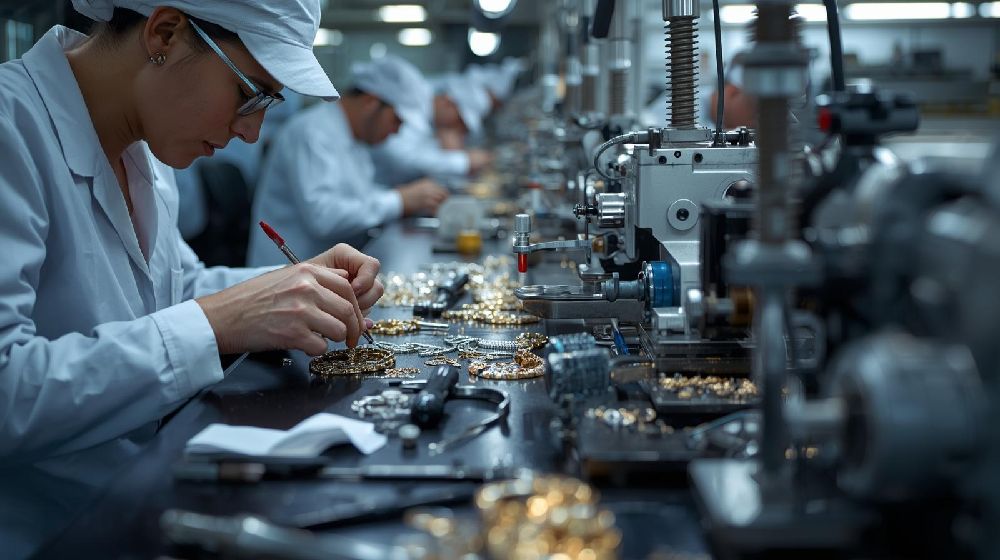
Behind every beautifully finished gold jewelry piece lies a complex and highly controlled manufacturing process. From raw gold to showroom-ready designs, a modern jewelry factory blends technology, craftsmanship, and precision quality control. This blog takes you inside a jewelry factory to explore each stage of the full production line.
1. Raw Gold Procurement & Purity Verification
The journey begins with sourcing certified raw gold bars or grains.
Key processes:
-
Purity verification using spectrometers and fire assay
-
Weight and density checks
-
Documentation for traceability and compliance
Only verified gold enters the production floor, ensuring quality from the start.
2. Alloying & Melting
Pure gold (24K) is alloyed to create usable karats like 22K, 18K, or 14K.
What happens here:
-
Precise mixing of gold with copper, silver, or zinc
-
Controlled melting in induction furnaces
-
Homogeneous alloy formation
This step defines the strength, color, and durability of the jewelry.
3. Casting or Wire & Sheet Formation
Depending on the design, gold takes different physical forms.
Common methods:
-
Casting: Wax patterns → tree assembly → investment → metal pouring
-
Wire drawing: For chains, bangles, and bracelets
-
Sheet rolling: For rings, pendants, and components
Accuracy at this stage minimizes material loss.
4. CNC & CAD-Based Manufacturing
Modern factories rely heavily on digital precision.
Technology used:
-
CAD modeling for exact dimensions
-
CNC machines for intricate patterns
-
Multi-axis engraving and texturing
This ensures design consistency, repeatability, and speed.
5. Laser Welding & Assembly
Laser welding has replaced traditional soldering in many factories.
Benefits include:
-
Invisible joints
-
Minimal gold loss
-
Heat-safe assembly for delicate designs
Complex components are assembled seamlessly at this stage.
6. Handcrafting & Detailing
Even in high-tech factories, skilled artisans play a vital role.
Hand processes include:
-
Filing and shaping
-
Texture enhancements
-
Stone setting preparation
This blend of human skill and technology brings character to each piece.
7. Stone Setting (If Applicable)
For diamond or CZ jewelry, stones are set with precision.
Techniques used:
-
Prong setting
-
Channel setting
-
Micro-setting using microscopes
Security and alignment are carefully checked.
8. Pre-Polishing & Surface Preparation
Before final shine, surfaces are prepared.
This includes:
-
Buffing
-
Edge smoothing
-
Scratch removal
Uniformity is essential before finishing.
9. Final Polishing & Finishing
This is where jewelry comes to life.
Finishing options include:
-
Mirror polish
-
Matte or satin finish
-
Hammered or brushed textures
Advanced polishing ensures brilliance without metal thinning.
10. Plating & Surface Treatments (Optional)
Certain designs receive additional treatments.
Examples:
-
Rhodium plating
-
Micro-plating
-
Anti-tarnish coatings
These enhance appearance and longevity.
11. Quality Control & Testing
Every piece undergoes strict inspection.
QC checks include:
-
Weight tolerance verification
-
Joint strength testing
-
Stone security checks
-
Visual inspection under magnification
Defective pieces are corrected or rejected.
12. Hallmarking & Certification
Certified jewelry is stamped for authenticity.
Includes:
-
Karat marking
-
Assay center verification
-
Manufacturer identification
Hallmarking ensures consumer trust and legal compliance.
13. Cleaning, Packaging & Dispatch
The final stage prepares jewelry for delivery.
Steps include:
-
Ultrasonic cleaning
-
Protective packaging
-
Batch labeling and documentation
Products are now showroom- and export-ready.
Conclusion
A jewelry factory is a world of precision, discipline, and artistry. Each stage—from alloying to hallmarking—is designed to protect purity, enhance beauty, and ensure reliability. Understanding this process builds trust and highlights the craftsmanship behind every gold jewelry piece.